- Seth’s Blog: Don’t Shave That Yak! – A thing that I do, which I shouldn't.
- SnapABug visual customer support – Another live support feature for your website, but this one includes screen capture to help troubleshooting.
- 13 Useful JavaScript Solutions for Charts and Graphs | Resources –
- Buzzzy – A Search Engine for Buzz. – Google Buzz search with an API.
- New Facebook Statistics Show Big Increase in Content Sharing, Local Business Pages – Facebook historical statistics as of February 2010 based on previous updates to their public statistics page.
- Lost Moon Radio: Live Band Karaoke With The Moon Units – Live band karaoke in LA. Available for parties and private events. Very fun!
- Fixed to Flexible – The Ebook – A free 37 page eBook on high-level microeconomic business theory with solid practical examples. The primary focus is on margin, specifically the pricing and cost strategies that go into that equation. It's a very quick read, concisely and clearly written with very illustrative (if somewhat over-simplified) examples.
For me, the most interesting ideas were on 'constructing value' for a previously unknown product. First, you need to have a compelling free offering so there is minimal risk to customers trying your new product. Secondly, you should take the lead in setting the perceived value of your new product by using an 'anchor' of premium pricing even if you end up selling at a discount to it.
- The Twitter Engineering Blog: Introducing the Open Source Twitter Text libraries – Twitter releases libraries for parsing tweets.
- Great Lake, a Chicago Pizza Shop, Enjoys Being Small – Question – NYTimes.com – A very interesting story about a small artisan pizza shop in Chicago that was reviewed in GQ as one of the best pizza shops in America and how they are (or rather aren't) dealing with their newfound success.
"We really enjoy the work that we’re doing and we don’t want to cheapen it. Consciously or unconsciously — probably both — we’re trying to create a manageable way to earn a living and still maintain our sanity. We value time as much, if not more so, than money."
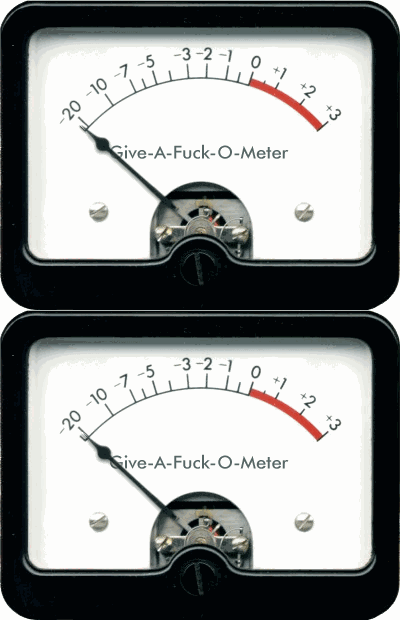
- Give-A-Fuck-O-Meter – Saving this to send to people in the future when they tell me something I could care less about.
- The Conservative Case for Gay Marriage – Conservative attorney Ted Olson, a member of the legal team challenging the federal constitutionality of California's Proposition 8 banning same-sex marriage, explains his rationale for participating in the case as a conservative American who wishes to preserve and forward the fundamental principles on which this country was founded:
"Conservatives and liberals alike need to come together on principles that surely unite us. Certainly, we can agree on the value of strong families, lasting domestic relationships, and communities populated by persons with recognized and sanctioned bonds to one another. Confining some of our neighbors and friends who share these same values to an outlaw or second-class status undermines their sense of belonging and weakens their ties with the rest of us and what should be our common aspirations." - YouTube – Sugar: The Bitter Truth – A very interesting, if long and sometimes quite technical (it is a med school lecture) explanation of the scientific, socio-economic, and political reasons our food is making us less healthy as a nation (and ultimately a planet) in the last 30 years. It centers around increasing our refined sugar intake, in particular fructose, which has the same long-term chronic health effects as alcohol.
- The Third & The Seventh on Vimeo – One of the most amazingly photo-real works of CG animation I've ever seen.
- Facebook Developers | Extending Facebook Share – Mention of awe.sm in the official Facebook blog post announcing their new sharecount button and data APIs.
- How Best Buy plans to beat Wal-Mart – Dec. 1, 2009 – A strategy to make Clayton Christensen proud. Best Buy is betting that the consumer electronics and computer markets have not yet reached a good enough point where cost is the only factor. By providing an integrated buying/service solution with their in-house Geek Squad division, Best Buy hopes to differentiate from retailers like Wal-Mart who are commoditizing the purchase experience. In this case Best Buy is playing the Apple Computer role to Wal-Mart's WinTel approach.
- What’s strategic for Google? – An interesting and concise analysis of Google's various product/business initiatives using a simple but intuitive strategic framework.
- 500 Internal Server Error – 500 Internal Server Error
- Entrepreneuring…Side Effects | Howard Lindzon – A humorous (but all too true) list of the potential side-effects of starting your own business.
- Paul Buchheit: Open as in water, the fluid necessary for life – A very interesting rationale for the potential common good of social media behavior that is increasingly referred to as "over-sharing". The more we share about what we think and do, the more information will be available to help improve ours and others' future decisions.
"The basic pattern of openness is that better access to information and better systems lead to better decisions and better living. This general principal is broadly accepted, but we're just now discovering that it also applies to the minutiae of our lives."
- The New Music Business Model: Imogen Heap « Deep Dive Marketing – A very thorough account of the many ways Imogen Heap is using different social media services (i.e. Twitter, YouTube, Flickr, uStream) as a cohesive whole to build deeper relationships with her most engaged fans.
- Ping – How Sharing Links Has Become Big Business – NYTimes.com – NY Times article on the democratization of influence on the web and the roll of individuals and their social networks as traffic drivers.
- 20×200 : Print Information : think-make-think (second edition) – If I were ever to hang an inspirational print on my wall, this would be it.
- Communilytics: Applied Community Analytics: Web 2.0 Expo New York 2009 – Co-produced by TechWeb & O’Reilly Conferences, November 16 – 19, 2009, New York, NY – Web 2.0 Expo panel on which I will be speaking on 11/16/2009
- Op-Ed Contributor – Wall Street Smarts – NYTimes.com – A deceptively simple (yet likely true) explanation of the underlying cause of the financial meltdown: the level of Wall Street’s intelligence finally caught up with that of its greed.
- Twitter to Facebook: 5 Ways to Post to Both – Mashable mention of TweetPo.st.
- Letters of Note: Okay, you lazy bitch – A great letter from Hunter S. Thompson to a production executive on film adaptation of his book “The Rum Diary.” If you know anything about the film business, you know that sometimes cursing and threats of bodily harm are more than appropriate, they’re necessary

- No. 1 With Bullets? USB Uzi Is Latest Killer Album Format | Underwire | Wired.com – Wired blog coverage of the upcoming release from Get Busy Committee, which will be available on Uzi-shaped USB drives.
- 100 years of Big Content fearing technology—in its own words – Ars Technica – A well-compiled overview of the arguments used by content industries to stifle various production and distribution innovations from the gramophone to the DVR. The overriding theme being that incumbent content producers are more inclined to seek government intervention (usually through sensationalist fear-mongering tactics) to protect old models in the face of new technologies rather than to figure out ways to improve their businesses to take full advantage of the benefits these technologies afford.
- Olark – sell better using live chat – Live chat tool to interact with customers on your website in real-time.
- 30 Under 30 2009 – Hype Machine Profile – Very nice write-up of my friend Anthony Volodkin, founder of the Hype Machine, named #27 in Inc. Magazine’s 30 Under 30 for 2009. He definitely should have been higher
- The power of no reward | Derek Sivers – An interesting article on the difference between ‘Social Mindset’ and ‘Market Mindset’. Actions driven out of personal volition are more authentic and the motivation is more powerful though more difficult to activate. Whereas actions driven out of financial calculation are by definition more mercenary — easier to activate, but of less value and harder to maintain. If you can appeal to someone’s ‘Social Mindset’, you cheapen your offer by invoking their ‘Market Mindset’.
- The Power Of Passed Links – A framework for thinking about the relative value of inbound traffic from different sources based on conversions (however one defines them) and growth. The hypothesis is that links passed from friend to friend via channels like Facebook and Twitter will have significantly higher conversions.
- Edward Sharpe and the Magnetic Zeroes: Get Wasted With The Day, In Robes recorded Aug 31, 2009 – Live session with Edward Sharpe and the Magnetic Zeros, including downloadable tracks.
- Official Google Blog: Leave the math to us: Advertisers increase their profits using Conversion Optimizer – “Each and every time someone types in a search query, AdWords runs a new keyword auction. Advertisers who are still bidding on a cost-per-click basis will be using the same bid in many different auctions, so sometimes their bid may be too high or too low. However, for advertisers using Conversion Optimizer, we’ll automatically adjust the bid for each of these auctions so that it can hit the sweet spot more often, helping the advertiser to make more money.”
- Seed is the new Series A for VCs | VentureBeat – A good overview on the move by later stage investors into earlier “seed” rounds along with advice for entrepreneurs on raising a pre-Series A round.
- Know all those Retweet Buttons across the web? Well now Facebook has one. – The first write-up on fbShare.me, from The Next Web.
- Awe.sm Lets You Track Articles Shared Into Facebook – Write-up of the latest Snowball Factory product, the fbShare.me sharecount button for Facebook.
- Secret of Googlenomics: Data-Fueled Recipe Brews Profitability – Purportedly a story on the role of Hal Varian, Google's chief economist, I found most interesting the history of how the AdWords bidding process was developed.
- Constructive Capitalism – Umair Haque – Daytona Sessions vol. 2 – A very in-depth (and thus long) talk by Umair Haque on the transition from 20th Century economics to 21th Century economics, which he calls Constructive Capitalism. He makes a lot of the same points as in his BRITE talk, but arguably less concisely.
- Where culinary dreams take shape, batch by batch – Los Angeles Times – A really cool concept of specialty food incubators, essentially commercial kitchen space for rent hourly. I wonder if something similar could be done as a restaurant with different chefs being able to rent out specific meals to do a part-time restaurant.
- Crimes suspected in 20 bailout cases — for starters – Los Angeles Times – The official charged with monitoring the bailout program says it lacks transparency and is very susceptible to fraud and abuse by participants.
- The Life and Times of A Twitter Link :: Blog :: Fuel Interactive – Based on anecdotal empirical testing, the average useful lifespan of a link shared on Twitter is only ~5 min.
- ConvoTrack – A bookmarklet (or embeddable script) for showing you all the conversations happening about a given page across the web (powered by BackType Connect).
While theoretically possible, I believe modeling the impact of these two factors is a practical impossibility because they are so intertwined — de-leveraging sparked the recession and the recession is driving further de-leveraging. You could also do a technical analysis where you try to match current market behavior to past patterns and extrapolate what happens next based on what happened before. But that method requires making a bet on which past patterns to match against, i.e. is our current situation more similar to the Great Depression or all the recessions since. And that’s a big bet.
So, I propose a different (and much simpler) approach: assume a realistically sustainable growth rate over a long enough period and figure out where we would be if the market had grown at that pace. I picked 20 years as the period and charted the monthly percent change of the Dow Jones Industrial Average (DJIA) from 2,342.32 at the end of January 1989 to 8,131.33 at Friday’s close. The actual percent change is the blue line, and I plotted 3 other lines against it: 10% annualized growth in green; 6% annualized growth in orange; and 2% annualized growth in red.
Here’s what that period looks like in annual percent change for the DJIA and S&P 500:
And here’s the annualized rate of return for both the S&P 500 and the DJIA since 1989:
Over the course of this 20 year period, there were only 6 years in which the market declined *at all* (one of which, 2005, was basically break-even) and there were 10 years in which the market gained *more than 10%* and in 7 of those it gained *more than 20%*. Even after the tech bubble “burst” taking the market from 11,497.12 at the end of 1999 to 8,341.63 at the end of 2002 (a 27.4% decline in 3 years), the market would still have delivered a *10.1%* annualized rate of return over the prior 12 years. From where we sit today, it’s no wonder the DJIA declined 33.85% in 2008 (taking us to a still very respectable annualized rate of return since 1989 of 7.24%). But that doesn’t answer the question of how much further down it needs to go before we can consider the value of the equity markets stable.
That’s where the annual growth rate analysis comes in. It is still highly subjective — depending on what one believes to be a representative sample period and sustainable annualized growth over that period. But I like it because it helps me think about the broader market in terms I feel more comfortable making assumptions about, like what do I think is a reasonable rate of value creation for the economy as a whole over a given period. In the case of the 20 years since 1989, do I believe there’s a reason that the equity markets should have averaged ~10% annual growth while our Real GNP achieved only 2.76% annual growth over the same period? No, and obviously neither does the market at this point.
So, what is a reasonable expectation for a bottom? Your guess on the underlying assumptions is as good as mine. But if one believes technical advancements over the last 20 year period enabled us to double efficiency (i.e. extract twice as much profit from the same revenues), then the markets *should* have grown at around twice the rate of Real GNP. In that case, we would be expecting 5.51% annualized growth in the markets since 1989 as of the end of 2008. Starting from 1989 closing prices of 2,753 on the DJIA and 353.4 on the S&P 500, 19 years of organic equity growth pegged at 2x GNP growth should have closed 2008 at 7,634.38 and 979.95, respectively (actuals were 8,766.39 and 903.25).
Update: Dad accurately points out that GNP is a trailing indicator and equity prices are leading indicators. So, this analysis shouldn’t be considered anything other than directional. I find it helpful as one factor in my overall assessment of the current situation, but as Howard reminds us no one really has all the answers.
This final chart shows the actual level of the DJIA (blue) compared to what it would be if it was pegged at 1x GNP Growth (red), 2x GNP Growth (orange), and 3x GNP Growth (green). It is essentially the same as the chart at the top but now instead of arbitrarily picking annual growth rates, we have pegged them as multiples of Real GNP (i.e. ratios of business efficiency). As you can see, for most of the last 20 years the markets were assuming >300% improvements in business efficiency.
All the above charts and underlying analysis can be found in this spreadsheet.
![Reblog this post [with Zemanta]](https://i0.wp.com/img.zemanta.com/reblog_c.png?w=840)
- 15 Places to Find Great Fonts | Lists | Tutorial Blog – A list of sites where one can find free fonts.
- The Quiet Coup – The Atlantic(May 2009) – A very interesting in-depth analysis of the rise of the financial oligarchy in the US over the last 20 years and how it has created dynamics similar to those of emerging market economic crises, according to a former chief economist of the IMF. “In a society that celebrates the idea of making money, it was easy to infer that the interests of the financial sector were the same as the interests of the country—and that the winners in the financial sector knew better what was good for America than did the career civil servants in Washington. Faith in free financial markets grew into conventional wisdom—trumpeted on the editorial pages of The Wall Street Journal and on the floor of Congress.”
- Digg support, Brazilian shortener, and all sorts of other awe.sm-ness « feed your blog to twitter – Announcement of the first third-party tool to officially support awe.sm

- L.A. starts buying up foreclosed homes with federal aid – Los Angeles Times – This is the best use of federal bailout money I've heard yet: the city of Los Angeles is buying up foreclosed residential properties and turning them into low-income housing. This is toxic-asset relief (buying foreclosed properties puts a value on their mortgages) with real equity for the government and a social benefit. I hope more funding goes towards programs like this.
- The Banker Who Said No – Forbes.com – A fascinating profile of banker D. Andrew Beal, who runs Texas-based Beal Bank. Beal Bank is privately held and approaching $7 billion. But the most interesting part is how they got there: by essentially sitting out the market 2004-2007. Seeing the state of the lending market in 2004, Beal essentially put his bank into hibernation by suspending new loans, hoarding cash, laying off half his workforce, and working half-days. Over the next 3 years, he was mocked by mortgage brokers and scrutinized by regulators for sitting on the sidelines. But his intuition, conviction, and self-restraint have paid off in a big way as he is now using his cash stockpile to acquire assets at pennies on the dollar. IMHO, no publicly traded bank would have been able to pull this off even if they had wanted to.
- Social Media ROI – Solid presentation on how to approach social media marketing from a quantitative perspective. Most interesting are the examples of different types of social media campaigns to drive different business goals. There is no one-size-fits all social media marketing campaign.
- The Lab – A web-based Sass -> CSS compiler. Sass is basically a shorthand way to write stylesheets for your website. It allows for nesting with two spaces. Also, it can do some basic math with constants. No more going around your CSS files updating the size or color of something.
- Newspapers and Thinking the Unthinkable « Clay Shirky – "When reality is labeled unthinkable, it creates a kind of sickness in an industry. Leadership becomes faith-based, while employees who have the temerity to suggest that what seems to be happening is in fact happening are herded into Innovation Departments, where they can be ignored en masse…With the old economics destroyed, organizational forms perfected for industrial production have to be replaced with structures optimized for digital data. It makes increasingly less sense even to talk about a publishing industry, because the core problem publishing solves — the incredible difficulty, complexity, and expense of making something available to the public — has stopped being a problem."
- Changing Nature of Virality: Facebook and Twitter – A consolidation of interesting stats from Hitwise on percentages of traffic to entertainment sites driven by Twitter and Facebook. For example, perezhilton.com's biggest week ever was driven primarily by traffic from Facebook (8.70%) over Google (7.62%). It is clear that for certain types of sites, particularly entertainment-oriented, 'viral' discovery is an increasingly important discovery mechanism being fueled by the growth of social media sites like Facebook and Twitter.
- The Rising Power Of Social Media As A Traffic Driver – Fred Wilson on the impact he's seeing to traffic on his own blog from Twitter and Facebook: "Links are the currency of the web and traffic is money so these are important trends for our portfolio companies and for everyone who does business on the web."
- Tony Hsieh: Zappos In The Business of Selling “Happiness” – This was a really great presentation that i was lucky enough to attend in person. Some of my favorite quotes were "Hire slowly, fire quicky", "When all your employees live the brand, you don't need to rely on marketing and PR to handle all your communications", and "We decided to take all the money we would have put into marketing and put it into making the customer experience better." While I do feel that Zappos sounds more like a management/corporate culture experiment than a business, I still think there are a ton of great lessons that less altruistic businesses can apply. My primary takeaway was probably on Slide 17 of the presentation, the idea of "Committable Core Values": having a company mission that is actionable for every employee.
- Economy Tech trends in 2009 by Mary Meeker (Morgan Stanley) – An omnibus presentation on the current economic climate and the high-level trends that will drive the technology industry in the near future. The first ~40 slides contain some really interesting data and charts on the larger macroeconomic situation and are worth looking at even for people not interested in the technology industry.
- The Memefication of Your Band – A more pragmatic take on the entertainment-as-a-service concept focused on how musical artists can more effectively promote themselves. "Your band must invade the Perception Economy. Your Band must no longer be a band. Your band must be a meme. A Meme Which Generates subMemes. These memes must be compelling, intriguing, and interesting enough for people to ‘follow’ or at least think that you are ‘worth following.’"
- High-tech Market Research and Consulting – Quantitative application of the Lanchester model, a WWII military strategy framework, to business in which market share is the proxy for number of troops. Interesting theoretical construct for understanding how players with differing market share should seek to compete in order to maximize their competitive advantage — i.e. smaller players should seek to segment a larger market into smaller pieces in which they can compete closer to market share parity while larger players should seek to compete in the broadest market possible to maximize the value of their dominance.
- WordPress › WP Greet Box « WordPress Plugins – A very useful WordPress plugin that shows visitors to your blog a unique greeting message depending on the page they are visiting from. E.g. Ask users coming from Digg.com to Digg your post, etc.
- Chat Catcher – An interesting service to help you track mentions of your blog posts across Twitter, FriendFeed and identi.ca and aggregate them back to your blog. The coolest thing is probably the 'Scriptless' version which can run on WordPress.com and other hosted blogs.
- Viral Arts: Making you money… Virally – A potentially interesting service that matches YouTube video producers with brands willing to pay them for product placement.
- The changing face of usability testing: Optimal Workshop releases free service called Treejack » VentureBeat – Basic DIY usability testing tools that allow you to test designs in the form of online surveys. Simple, elegant, and IMHO 80/20 effective (vs full-service usability testing software).
- Why Bit.ly Will Upstage Digg – Definitely what I would be working on if I was in charge of bit.ly. While analytics were the initial draw for sharers to use bit.ly, recognition as an influencer could be a differentiator now that others like cli.gs and tr.im are commoditizing analytics for shortened URLs. I totally agree with Om that a bit.ly powered Digg (Bigg?) would produce much more interesting and representative results than Digg, which has come to be dominated by an idiosyncratic user community. Also, I think it would be foolish of Bigg to be reserved to bit.ly URLs. Why wouldn't they want share/click data from all the shortened URLs they can get it for?
- Topspin » “Josh Freese. What are you doin’? This summer.” – Brilliant (and hilarious) showcase of how the internet can make even the way you sell your art part of the experience. Definitely worth the read! My favorite is the $10k package, which includes: "Josh takes you and a guest to Club 33 (the super-duper exclusive and private restaurant at Disneyland located above Pirates of the Caribbean) and then hit a couple rides afterward (preferably the Tiki Room, the Haunted Mansion and Tower of Terror) / At the end of the day at Disneyland, drive away in Josh’s Volvo station wagon. It’s all yours … take it. Just drop him off on your way home, though, please."
- Relationship Symmetry in Social Networks: Why Facebook will go Fully Asymmetric – Bokardo – A very interesting analysis of the difference between the asymmetric relationship model of Twitter (arguably pioneered by Flickr) and the mostly symmetric relationship model of Facebook today and why the reality of attention inequality is a barrier to Facebook's growth as long as they stick to symmetric relationships.
(Un)classes are to continuing education what BarCamps are to conferences — a lightweight, low-pressure, and most of all fun way to explore topics that interest you without having to make a big up-front commitment.
Rahmin is one of those guys with a million ideas, and there’s something to almost all of them, but this one struck a chord with me. It was a product *I* really wanted, which is always a good sign. So, I started to think about why I wanted it and I came up with two fundamental themes that I think are resonant with a growing number of people.
Diversified Living
When I left Yahoo! a little over a year ago, I had spent nearly 4 years as close to singularly focused on work as humanly possible. Over those four years, I invested all of my life capital (i.e. time) in my career, which I thought was a sure-fire investment that would have a much higher rate of return than conventional instruments like hobbies and relationships — those only paid incremental quotidian returns, this could pay exponential life-changing ones. But then I was hit by a Black Swan in the form of Yahoo!’s well-documented struggles. And all of a sudden, a good portion of the capital I had accrued from my investment was in the form of influence within a company at which I was no longer interested in working.
So when I left, I vowed not to make that mistake again. I was not going to put all my capital into one life investment vehicle that could unexpectedly lose its value, I was going to diversify. I realized that life experience (i.e. travel, hobbies, etc) may not have a sexy upside, but it’s safe and pays a solid dividend. Whatever was to come next career-wise would never be a singular focus at the absolute expense of life experience.
However, I’m more than a little OCD (in the annoying perfectionist way, not the need to lock the door 7 times and spin around way) and I throw myself fully into what I do because I don’t know any other way. So, this new goal of life diversification would have to take forms that didn’t require an abundance of free time. But, there aren’t too many meaningful things you can do with a relatively small amount of sporadic spare time beyond read a novel or paint. You definitely can’t learn a new skill or study a subject that interests you, at least not through any conventional educational offerings of which I’m aware. And that’s where (un)classes fills a market void for me, it’s micro-education (Rahmin’s term) — a learning format with smaller basic units that fit my crazy lifestyle.
Weaponization of Hobbies
(First of all, credit to Raza for the term.) If micro-education is a format, then casual learning is a category within that format. What sets casual learning apart from other potential categories of micro-education is the inherent lack of competition, which appeals to my desire for my extra-curricular activities to be enjoyable and stress-free.
Don’t get me wrong, I’m a competitive guy. But, I think it’s somewhat ridiculous that you can go pro and/or compete in pretty much anything nowadays. Stuff that was meant to be fun has now been turned competitive at the highest levels, and I would argue that has trickled down to permeate every level of a given hobby to some degree. There is a certain expectation that by taking classes you are (at least in theory) fully committed to one day becoming an expert in that subject. And by not pursuing the next level once you get there, you are quitting. This implicit expectation can be very daunting for novices or dabblers and serves to keep people from even trying. What if I just care enough to only ever be a beginner?
And then there are the other students. Haven’t we all been there in the beginners’ sailing class with the guy who brought his own life-vest and keeps trying to complete the instructor’s sentences or in the introductory rock-climbing class with the guy who keeps volunteering how he’s only trying to get back in the swing of things after taking a few years off? I don’t want to spend my precious free time dealing with these people! Like I said, I’m competitive. So even if I’m not there to compete, I’ll end up taking it seriously just to shut that douchebag up.
Casual Learning FTW!
I believe both these themes, diversified living and a rebellion against the weaponization of hobbies, appeal to a lot of people who may not even know it yet or are just beginning to realize it.
The current recession has made diversified living not just something the growing ranks of the white-collar unemployed may see as a silver-lining until they find their next job, but a core value that will stay with them for the rest of their lives. The macro-economic Black Swan of the credit crisis is trickling down to become millions of personal Black Swans just like mine. Our generation that was trained to sacrifice everything short-term for our careers and the long-term benefits of professional success is seeing the foundational assumptions of that philosophy spectacularly undermined before our eyes. If all of a sudden I don’t reasonably believe that I’ll be able to make $10M by the age of 40, is the way I’ve been living my life worth the opportunity costs?
As for the weaponization of hobbies, everyone hates douchebags. ‘Nuff said.
Casual learning is unique in that it is purely learning for fun. By its very nature it can’t help you with professional training or becoming an expert at anything. And so, you end up with a self-selecting group of participants who are all there for the same reasons. What makes casual learning special is the community of intellectually curious individuals who want to pursue the joy of learning without having to make a substantive commitment to do so. (Un)classes fill the gap between nothing and full commitment to a subject matter and do so within a supportive and non-competitive group of like-minded individuals.
(un)classes.com
We’re trying to launch the first version of (un)classes.com in time for LaidOffCamp this Tuesday. Rahmin and I are working on product and marketing, Marcus is helping out with design, the fantastic guys at Cloudspace — Corey, Michael, and Tim (who also happen to be the guys behind awe.sm) — are doing the development heavy lifting, and Todd has even offered to chip in on some CSS work. It’s a side-project for everyone involved that basically kicked off Thursday night, and it will be nothing short of a miracle if we pull it off (and I promise to write about the process if we do). But we’re all really passionate about the possibilities of the idea and the community it can create, and we want to start using this product ourselves.
If you made it this far, there’s a high likelihood you’re digging on the idea of (un)classes as much as we are, and you’re wishing there was a way to get involved right now. Well, today is your lucky day! Even though the site isn’t up yet, Rahmin setup a way for you to submit ideas for things you wanna learn and things you wanna teach. When the site goes live, your submissions will be the first classes in there and you will get an email with your account info. Of course, you can also follow (un)classes on Twitter and/or subscribe to the (un)classes blog.
- HTML URL Encoding Reference – Handy table of the URL encoded values for ASCII characters.
- A foot and a half: Finally, A Use for Twitter – Greatest Twitter story evar! I actually saw these tweets from @the_real_shaq while this was happening, now we get the backstory from the guys for whom they were intended. I <3 Shaq!
- The Crisis of Credit Visualized – Astute, approachable, and just plain pretty animated explanation of our current economic situation. Oh, and did I mention INCREDIBLY FRIGHTENING!? Once you realize how simple, and thus fundamental, the underlying problems are, it becomes very difficult to believe in a quick or easy fix. Now, back to stuffing my remaining cash into my mattress…
- How Freshbooks Built an Army of Passionate Evangelists on Twitter. How are YOU doing so? | Blog of Mr. Tweet – A great story from a company passionate about serving customers and building relationships with them (CRB = customer relationship building) and how they extended the reach of that passion through Twitter. Worth the read.
- The Missing Google Analytics Manual | FutureNow’s GrokDotCom / Marketing Optimization Blog – A comprehensive collection of the most helpful links and videos to teach you how to get the most out of Google Analytics.
- Coding Horror: Commandos, Infantry, and Police – Quotation of a legendary analogy from Robert X. Cringely’s “Accidental Empires” published in 1993. Cringely characterizes the successive waves of employees who staff a company through its lifecycle from startup to industry leader to incumbent as commandos, infrantry, and military police, respectively.”The [commandos’] job is to do lots of damage with surprise and teamwork, establishing a beachhead before the enemy is even aware that they exist. Ideally, they do this by building the prototype of a product that is so creative, so exactly correct for its purpose that by its very existence it leads to the destruction of other products. They make creativity a destructive act.”
- Add Community to your Site with Triggit! – An interesting idea of using Twitter as a platform to create user communities for your site (a la MyBlogLog). The differentiator is supposed to be that the community discussions happen publicly on Twitter, thus driving more traffic to your site.
- GroupTweet – Cool simple tool to create what are essentially Twitter group mailing lists. You set up a Twitter account for your group, register it with GroupTweet, and then it’s just a bot that RTs any DMs sent to the group account. In order for a group member to be able to post to the whole group, they need to be followed by the group account. And you can control who reads the group messages by protecting the group account’s updates. Simple, elegant, effective.
- Analytics Talk » Blog Archive » Tracking Sub Domains with Google Analytics – Best article I could find on how to track subdomains properly in Google Analytics. Surprised they don’t do it right out of the box. But, these easy to follow instructions and screenshots will get you sorted quickly.
- Tube Mogul Buys Video Analytics Firm - "TubeMogul currently has over 40,000 users, ranging from networks and studios such as CBS, to web only video producers and bloggers like 'Fred.' Illumenex current clients include Internet TV pioneer Revision3 and comedy site 'eBaum’s World.'”
- "Don't forget..." - a set on Flickr - Really cool street art project in Berlin (where else) that is adding Photoshop interface elements to billboards to remind passers-by that these images of beauty are artificially enhanced. (via https://addons.mozilla.org/en-US/firefox/addon/9591)
- Facebook Developers | Facebook Developers News - Facebook is now allowing custom FBML tags, essentially code libraries produced by 3rd party application developers that can be used by other application developers to add functionality from one app to another. This opens the door to officially sanctioned mash-ups of Facebook apps, which are already mash-ups in themselves. Using the term mash-up in a non-ironic fashion makes me want to punch myself.
- The Inauguration of President Barack Obama - The Big Picture - Boston.com - A poignant collection of photos of Barack Obama's inauguration and the reactions to it around the world. My favorite is the American soldier in Iraq crying tears of joy (#19). The fact that the routine transfer of power in our country can inspire such powerful reactions around the world is evidence of what a truly global world in which we now we live. And I believe it shows that we as American citizens are making progress towards redeeming ourselves in the eyes of the world, who hold *us* (not just our leaders) accountable for the actions of our nation.
- Transcript - Barack Obama’s Inaugural Address - Text - NYTimes.com - Text of Obama's inaugural address.
- Rev. Lowery Inauguration benediction. Transcript. - Lynn Sweet - "Lord, in the memory of all the saints who from their labors rest, and in the joy of a new beginning, we ask you to help us work for that day when black will not be asked to get back, when brown can stick around -- (laughter) -- when yellow will be mellow -- (laughter) -- when the red man can get ahead, man -- (laughter) -- and when white will embrace what is right."
- Resources Every WordPress Theme Developer Should Know About! | Arbenting - A comprehensive list of resources for WordPress Theme development.
- YouTube Videos Pull In Real Money - NYTimes.com - Many have long claimed that the only profitable type of online video content was repurposed TV shows/films or other "professionally produced" content. This article give several examples dispelling that myth and showing that the online video audience and business has reached a point where even so-called amateurs can make real money. For example, Michael Buckley is making >$100k/year from his homegrown entertainment news show "What the Buck?" purely through YouTube's partner program.
- Op-Ed Contributors - The End of the Financial World as We Know It - NYTimes.com - Comprehensive (if not revelatory) overview of some of the primary drivers of the financial bubble and resulting collapse by Michael Lewis and David Einhorn. Puts things like the failures of the ratings agencies and the greed of financial services company shareholders, which have been examined more deeply on their own, into the broader context of our current hindsight.
- YouTube Is Changing How We Think About Video | Techdirt - "The power of YouTube is that it enables something entirely new and different to emerge and to thrive. In the history of disruptive innovations, merely taking a product from one medium and moving it to another usually doesn't get very far. It's the projects that really embrace the new possibilities that are only possible via that new medium that really make an impact."
- Tube Mogul Buys Video Analytics Firm – "TubeMogul currently has over 40,000 users, ranging from networks and studios such as CBS, to web only video producers and bloggers like 'Fred.' Illumenex current clients include Internet TV pioneer Revision3 and comedy site 'eBaum’s World.'”
- "Don’t forget…" – a set on Flickr – Really cool street art project in Berlin (where else) that is adding Photoshop interface elements to billboards to remind passers-by that these images of beauty are artificially enhanced. (via https://addons.mozilla.org/en-US/firefox/addon/9591)
- Facebook Developers | Facebook Developers News – Facebook is now allowing custom FBML tags, essentially code libraries produced by 3rd party application developers that can be used by other application developers to add functionality from one app to another. This opens the door to officially sanctioned mash-ups of Facebook apps, which are already mash-ups in themselves. Using the term mash-up in a non-ironic fashion makes me want to punch myself.
- The Inauguration of President Barack Obama – The Big Picture – Boston.com – A poignant collection of photos of Barack Obama's inauguration and the reactions to it around the world. My favorite is the American soldier in Iraq crying tears of joy (#19). The fact that the routine transfer of power in our country can inspire such powerful reactions around the world is evidence of what a truly global world in which we now we live. And I believe it shows that we as American citizens are making progress towards redeeming ourselves in the eyes of the world, who hold *us* (not just our leaders) accountable for the actions of our nation.
- Transcript – Barack Obama’s Inaugural Address – Text – NYTimes.com – Text of Obama's inaugural address.
- Rev. Lowery Inauguration benediction. Transcript. – Lynn Sweet – "Lord, in the memory of all the saints who from their labors rest, and in the joy of a new beginning, we ask you to help us work for that day when black will not be asked to get back, when brown can stick around — (laughter) — when yellow will be mellow — (laughter) — when the red man can get ahead, man — (laughter) — and when white will embrace what is right."
- Resources Every WordPress Theme Developer Should Know About! | Arbenting – A comprehensive list of resources for WordPress Theme development.
- YouTube Videos Pull In Real Money – NYTimes.com – Many have long claimed that the only profitable type of online video content was repurposed TV shows/films or other "professionally produced" content. This article give several examples dispelling that myth and showing that the online video audience and business has reached a point where even so-called amateurs can make real money. For example, Michael Buckley is making >$100k/year from his homegrown entertainment news show "What the Buck?" purely through YouTube's partner program.
- Op-Ed Contributors – The End of the Financial World as We Know It – NYTimes.com – Comprehensive (if not revelatory) overview of some of the primary drivers of the financial bubble and resulting collapse by Michael Lewis and David Einhorn. Puts things like the failures of the ratings agencies and the greed of financial services company shareholders, which have been examined more deeply on their own, into the broader context of our current hindsight.
- YouTube Is Changing How We Think About Video | Techdirt – "The power of YouTube is that it enables something entirely new and different to emerge and to thrive. In the history of disruptive innovations, merely taking a product from one medium and moving it to another usually doesn't get very far. It's the projects that really embrace the new possibilities that are only possible via that new medium that really make an impact."