 Apple’s acquisition of Lala yesterday is the coda to an interesting chapter in the evolution of the music industry. It comes on the heels of MySpace’s acquisitions of iLike and iMeem (both at similarly distressed prices to the reported ~50% discount in the Lala deal) as well as the launch of (nearly) inline streaming music in Google’s search results. Talk about mixed messages: the business of on-demand streaming music (vs. streaming radio like Pandora) is broadly being conceded as a failure just as the user experience is finally hitting the mainstream.
In the last 24hrs, I’ve read a lot of analysis across the spectrum and heard the thoughts of friends in various segments of the music industry. Here are some of the big issues that are front of my mind.
Whither the MP3 of streaming music?
Most of the people I respect in online music have been opining for on-demand streaming music for years. So, their first reaction has echoed that of my friend Lucas: music in the cloud will now be a reality. But *how* it will become a reality matters too, and I think that’s been lost a bit in the discussion so far.
In the download world, an open format (MP3) pre-dated Apple’s entry. So, they had no choice but to support it in order to make their software and devices backwards compatible. In fact, it’s easy to forget today that the market for iTunes and the iPod was largely built around satisfying the needs of consumers of illegally acquired music (the iTunes Music Store was actually launched over 2 years after iTunes debuted). If not for that pre-existing market condition, I don’t think it’s hard to believe the iPod would only play AAC music files (Apple’s proprietary format). Remember that no one could compete with the iTunes Music Store as a legitimate storefront for online music until less than two years ago, when the labels agreed to let Amazon and others sell in MP3 format so that customers could play the songs sold by retailers other than Apple on iPods. (This in itself was an interesting saga with Jobs publicly justifying why Apple would never support someone else’s proprietary format on their software/devices and why they would never license Apple’s DRM to others. In the end, the labels’ fear of Apple’s growing control of the online music value chain was greater than their fear of piracy and they called Jobs’s bluff by actually licensing MP3 sales.)
The relevance here is that there is no MP3 equivalent for streaming music — no pre-existing open standard that consumers will require Apple to support before they buy a wifi-enabled iPod (aka iPod Touch). Just like there is no (legitimate) way to play films or tv shows not downloaded from the iTunes Store on your Apple TV, there will be no way to consume on-demand streaming music from other sources in the native player on your iPod. You will of course continue to be able to install separate third-party applications, like Pandora or Spotify, to manage and play streaming music you acquire through those services. But, that silo will continue to be incompatible with iTunes and the rest of your music library while the native player will offer you an integrated consumption experience across downloaded and streaming music. Maybe this will still be good enough for the small number of power-users who care enough to want an alternative to the Apple offering (like those of us today who install the eMusic or Amazon download manager to have a somewhat equivalent purchase alternative to the iTunes Music Store).
However the segment for whom I think the lack of an open streaming music standard is potentially most harmful is the actual artists and the growing industry of direct-to-fan enablers, including my good friends at Topspin. Direct-to-fan sales are better for the artist because they get to own the customer relationship with the people who are *their* fans to begin with (see my boy Ian explaining to Wired how important this is) and they can have more control of the offering and better margins by cutting out middle-men like Apple. Today, I can buy an album directly from Topspin artists like Get Busy Committee or Fitz & The Tantrums (two of my current faves) in MP3 format and play it in iTunes and on my iPod. How exactly are they going to sell me streaming music outside of iTunes (or a 3rd-party service)? There are products like MobileRoadie, which artists can use to create their own branded iPhone/iPod app. But, I don’t foresee consumers being willing to switch apps every time they want to hear a new artist (and forget about a streaming playlist with multiple artists).
Licenses, schmicenses!
Several commentators on the Lala deal have noted that their licenses with the labels expire in the case of an acquisition. And I hear from insiders that Apple has already had requests for streaming licenses denied by at least some labels. Here’s why neither of those things matter.
Apple is going to build a kick-ass streaming experience natively integrated into their service/software/device stack of the iTunes Music Store, iTunes, and the iPod. They are going to get the thousands of independent labels, aggregators like TuneCore who represent individual artists, and at least one or two major labels (my bet is EMI will be first) to give them streaming licenses on a critical mass of music. Then, they are going to use the iTunes Music Store to promote the shit out of both downloads and streaming (most likely bundled) from the artists for whom they have streaming licenses while at the same time freezing out promotions for any hold-outs.
This is a non-issue IMHO and every song you can buy as a download from the iTunes Music Store today will be available for streaming within a year of launch (just ask NBC how well playing chicken with Apple works).
Sustaining innovation doesn’t work.
This post is already way longer than I intended, so I’ll leave this point as more of a footnote. On-demand streaming music is the future. Everyone I respect believes it, Apple believes it, it is the logical conclusion of the path the music consumer experience has been on since Napster. And yet it is a business widely viewed as “toxic” by investors, several of whom in recent months have demonstrated they think so little of its future potential that they are willing to take steep losses on their investments to get out. What gives?
Not only were these businesses endorsed by the major labels, both iMeem and Lala actually had labels as investors (as does Spotify). The reason that on-demand streaming music is a great product but shitty business is because the license fees demanded by the labels make it impossible to make money with any kind of offering that consumers will think is reasonable. It’s somewhat counter-intuitive that a vendor who is an investor wouldn’t be willing to adjust their pricing in order to preserve the value of their investment. But Warner Records, in particular, made it clear that are happy to spend tens of millions of dollars co-opting companies they see as potential threats and running them out of business in order to prevent hundreds of millions of dollars in (perceived) cannibalization.
This is Clayton Christensen 101:
By only pursuing ‘sustaining innovations’ that perpetuate what has historically helped them succeed, companies unwittingly open the door to ‘disruptive innovations’.
In other words, by trying to take an innovation and use it only to perpetuate and/or protect legacy business models, incumbents give new entrants the opportunity to do things the way the market actually wants them to be done regardless of how they have been done in the past. By trying to force LaLa from being a potentially disruptive innovation into a sustaining innovation, Warner Music and the other major labels unintentionally drove them into the arms of Apple, still the biggest threat to the legacy model the labels are trying to preserve. (Studios and networks trying to “de-fang” Hulu, take note.)

- Seth’s Blog: Don’t Shave That Yak! – A thing that I do, which I shouldn't.
- SnapABug visual customer support – Another live support feature for your website, but this one includes screen capture to help troubleshooting.
- 13 Useful JavaScript Solutions for Charts and Graphs | Resources –
- Buzzzy – A Search Engine for Buzz. – Google Buzz search with an API.
- New Facebook Statistics Show Big Increase in Content Sharing, Local Business Pages – Facebook historical statistics as of February 2010 based on previous updates to their public statistics page.
- Lost Moon Radio: Live Band Karaoke With The Moon Units – Live band karaoke in LA. Available for parties and private events. Very fun!
- Fixed to Flexible – The Ebook – A free 37 page eBook on high-level microeconomic business theory with solid practical examples. The primary focus is on margin, specifically the pricing and cost strategies that go into that equation. It's a very quick read, concisely and clearly written with very illustrative (if somewhat over-simplified) examples.
For me, the most interesting ideas were on 'constructing value' for a previously unknown product. First, you need to have a compelling free offering so there is minimal risk to customers trying your new product. Secondly, you should take the lead in setting the perceived value of your new product by using an 'anchor' of premium pricing even if you end up selling at a discount to it.
- The Twitter Engineering Blog: Introducing the Open Source Twitter Text libraries – Twitter releases libraries for parsing tweets.
- Great Lake, a Chicago Pizza Shop, Enjoys Being Small – Question – NYTimes.com – A very interesting story about a small artisan pizza shop in Chicago that was reviewed in GQ as one of the best pizza shops in America and how they are (or rather aren't) dealing with their newfound success.
"We really enjoy the work that we’re doing and we don’t want to cheapen it. Consciously or unconsciously — probably both — we’re trying to create a manageable way to earn a living and still maintain our sanity. We value time as much, if not more so, than money."
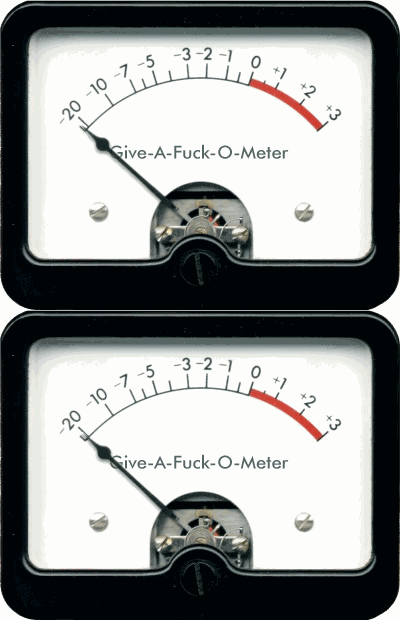
- Give-A-Fuck-O-Meter – Saving this to send to people in the future when they tell me something I could care less about.
- The Conservative Case for Gay Marriage – Conservative attorney Ted Olson, a member of the legal team challenging the federal constitutionality of California's Proposition 8 banning same-sex marriage, explains his rationale for participating in the case as a conservative American who wishes to preserve and forward the fundamental principles on which this country was founded:
"Conservatives and liberals alike need to come together on principles that surely unite us. Certainly, we can agree on the value of strong families, lasting domestic relationships, and communities populated by persons with recognized and sanctioned bonds to one another. Confining some of our neighbors and friends who share these same values to an outlaw or second-class status undermines their sense of belonging and weakens their ties with the rest of us and what should be our common aspirations." - YouTube – Sugar: The Bitter Truth – A very interesting, if long and sometimes quite technical (it is a med school lecture) explanation of the scientific, socio-economic, and political reasons our food is making us less healthy as a nation (and ultimately a planet) in the last 30 years. It centers around increasing our refined sugar intake, in particular fructose, which has the same long-term chronic health effects as alcohol.
- The Third & The Seventh on Vimeo – One of the most amazingly photo-real works of CG animation I've ever seen.
- Facebook Developers | Extending Facebook Share – Mention of awe.sm in the official Facebook blog post announcing their new sharecount button and data APIs.
- How Best Buy plans to beat Wal-Mart – Dec. 1, 2009 – A strategy to make Clayton Christensen proud. Best Buy is betting that the consumer electronics and computer markets have not yet reached a good enough point where cost is the only factor. By providing an integrated buying/service solution with their in-house Geek Squad division, Best Buy hopes to differentiate from retailers like Wal-Mart who are commoditizing the purchase experience. In this case Best Buy is playing the Apple Computer role to Wal-Mart's WinTel approach.
- What’s strategic for Google? – An interesting and concise analysis of Google's various product/business initiatives using a simple but intuitive strategic framework.
- 500 Internal Server Error – 500 Internal Server Error
- Entrepreneuring…Side Effects | Howard Lindzon – A humorous (but all too true) list of the potential side-effects of starting your own business.
- Paul Buchheit: Open as in water, the fluid necessary for life – A very interesting rationale for the potential common good of social media behavior that is increasingly referred to as "over-sharing". The more we share about what we think and do, the more information will be available to help improve ours and others' future decisions.
"The basic pattern of openness is that better access to information and better systems lead to better decisions and better living. This general principal is broadly accepted, but we're just now discovering that it also applies to the minutiae of our lives."
- The New Music Business Model: Imogen Heap « Deep Dive Marketing – A very thorough account of the many ways Imogen Heap is using different social media services (i.e. Twitter, YouTube, Flickr, uStream) as a cohesive whole to build deeper relationships with her most engaged fans.
- Ping – How Sharing Links Has Become Big Business – NYTimes.com – NY Times article on the democratization of influence on the web and the roll of individuals and their social networks as traffic drivers.
- 20×200 : Print Information : think-make-think (second edition) – If I were ever to hang an inspirational print on my wall, this would be it.
- Communilytics: Applied Community Analytics: Web 2.0 Expo New York 2009 – Co-produced by TechWeb & O’Reilly Conferences, November 16 – 19, 2009, New York, NY – Web 2.0 Expo panel on which I will be speaking on 11/16/2009
- Op-Ed Contributor – Wall Street Smarts – NYTimes.com – A deceptively simple (yet likely true) explanation of the underlying cause of the financial meltdown: the level of Wall Street’s intelligence finally caught up with that of its greed.
- Twitter to Facebook: 5 Ways to Post to Both – Mashable mention of TweetPo.st.
- Letters of Note: Okay, you lazy bitch – A great letter from Hunter S. Thompson to a production executive on film adaptation of his book “The Rum Diary.” If you know anything about the film business, you know that sometimes cursing and threats of bodily harm are more than appropriate, they’re necessary

- No. 1 With Bullets? USB Uzi Is Latest Killer Album Format | Underwire | Wired.com – Wired blog coverage of the upcoming release from Get Busy Committee, which will be available on Uzi-shaped USB drives.
- 100 years of Big Content fearing technology—in its own words – Ars Technica – A well-compiled overview of the arguments used by content industries to stifle various production and distribution innovations from the gramophone to the DVR. The overriding theme being that incumbent content producers are more inclined to seek government intervention (usually through sensationalist fear-mongering tactics) to protect old models in the face of new technologies rather than to figure out ways to improve their businesses to take full advantage of the benefits these technologies afford.
- Olark – sell better using live chat – Live chat tool to interact with customers on your website in real-time.
- 30 Under 30 2009 – Hype Machine Profile – Very nice write-up of my friend Anthony Volodkin, founder of the Hype Machine, named #27 in Inc. Magazine’s 30 Under 30 for 2009. He definitely should have been higher
- The power of no reward | Derek Sivers – An interesting article on the difference between ‘Social Mindset’ and ‘Market Mindset’. Actions driven out of personal volition are more authentic and the motivation is more powerful though more difficult to activate. Whereas actions driven out of financial calculation are by definition more mercenary — easier to activate, but of less value and harder to maintain. If you can appeal to someone’s ‘Social Mindset’, you cheapen your offer by invoking their ‘Market Mindset’.
- The Power Of Passed Links – A framework for thinking about the relative value of inbound traffic from different sources based on conversions (however one defines them) and growth. The hypothesis is that links passed from friend to friend via channels like Facebook and Twitter will have significantly higher conversions.
- Edward Sharpe and the Magnetic Zeroes: Get Wasted With The Day, In Robes recorded Aug 31, 2009 – Live session with Edward Sharpe and the Magnetic Zeros, including downloadable tracks.
- Official Google Blog: Leave the math to us: Advertisers increase their profits using Conversion Optimizer – “Each and every time someone types in a search query, AdWords runs a new keyword auction. Advertisers who are still bidding on a cost-per-click basis will be using the same bid in many different auctions, so sometimes their bid may be too high or too low. However, for advertisers using Conversion Optimizer, we’ll automatically adjust the bid for each of these auctions so that it can hit the sweet spot more often, helping the advertiser to make more money.”
- Seed is the new Series A for VCs | VentureBeat – A good overview on the move by later stage investors into earlier “seed” rounds along with advice for entrepreneurs on raising a pre-Series A round.
- Know all those Retweet Buttons across the web? Well now Facebook has one. – The first write-up on fbShare.me, from The Next Web.
- Awe.sm Lets You Track Articles Shared Into Facebook – Write-up of the latest Snowball Factory product, the fbShare.me sharecount button for Facebook.
- A Band That Knows Where the Money Comes From – Gadgetwise Blog – NYTimes.com – Chester French are one of the savviest artists about using social media (and more conventional CRM tools like email and Salesforce) to build and cultivate their fan-base.
- Thingfo powers Biggest Gleek social media game for Fox hit “GLEE” – finding, channeling and rewarding the top evangelists at Thingfo blog – Announcement of the new social media game for the Fox TV show Glee, built by Thingfo and powered by awe.sm.
- Facebook | Publishing to Twitter from Facebook Pages – Facebook has released a feature that enables Fan Page owners to syndicate their updates to Twitter automatically.
- 500 Internal Server Error – 500 Internal Server Error
- Peer-to-peer ‘(un)classes’ match interest with passion – Springwise – Another nice write-up of (un)classes.
- Unclasses.org Launches | Culture San Francisco – DailyCandy – A nice (if oblique) write-up in Daily Candy SF on my side-project (un)classes.
- Raphaël—JavaScript Library – Raphaël is a small JavaScript library that should simplify your work with vector graphics on the web. If you want to create your own specific chart or image crop and rotate widget, for example, you can achieve it simply and easily with this library. Used by Thingfo.com.
- Hitwise Intelligence – Robin Goad – UK – An interesting post about Twitter traffic growth in the UK. But, the most interesting part is the chart showing sources of traffic for various vertical categories of websites. Notably that over 40% of traffic to sites in the 'Entertainment' category is coming from either Twitter or Facebook. This reinforces my hypothesis that social media is a particularly powerful marketing channel for content.
- The Smart Growth Manifesto – Umair Haque – HarvardBusiness.org – 20th century economies are limited to unsustainable, unfair, brittle, dumb growth. Smart growth is more sustainable, equitable, and resilient based on 4 pillars:
1) Outcomes, not incomes
2) Connections, not transactions
3) People, not product
4) Creativity, not productivity
The inefficient legacy technologies for measuring growth forced us to reduce our understanding of it to purely quantitative terms that don't accurately represent the whole point of progress: to advance humankind. People do not measure happiness and satisfaction in purely quantitative terms, yet those have become our de facto measures of success. Now that we have the capabilities to measure the effects of qualitative goods, we should abandon our legacy tactics that reduce progress to mere numbers. - Confessions of an Executive Producer: earn it – "The irony is consumers have never been easier to find but never harder to reach. As I see it brand/consumer relationship is analogous to that of a married man to his mistress. For years the affair was a simple proposition. He wined and dined her. Bought her jewelery. Paid her rent. In return he got laid and left guilt free at the end of the evening. After years of this pattern, the mistress begins to feel used and unsatisfied. She desires more than material goods. She wants conversation. She wants to be listened to. She wants to be in a relationship. Much to the displeasure of the adulterer, sex can no longer be bought. It has to be earned. I believe the same thing is happening today with the brand/consumer relationship. Brands must earn consumers time not simply purchase it. The problem is they don't know how and don't seem eager to learn."
- Tweetpo.st – Update Facebook & Twitter At The Same Time | Visit tweetpo.st – Write-up of TweetPo.st on the Killer Startups blog.
- TweetPo.st – the smart way to update Facebook from Twitter « EverythingTwitter – Write-up of TweetPo.st on the Everything Twitter blog.
- TweetPo.st, aggiorna facilmente Facebook da Twitter – Geekissimo – A write-up of TweetPo.st on an Italian technology blog.
- TweetPo.st – a smarter way to update FaceBook from twitter – A write-up of TweetPo.st on twi5, a Twitter tools site.
- Master of 500 Hats: How to Pitch a VC (aka Startup Viagra: How to Give a VC a Hard-On) – Dave McClure's excellent presentation on how to structure a startup investor pitch (oh, and it's funny too).
- the blip.tv blog : blip.tv: the next generation – "Over the course of the last century the television networks (and their younger cable siblings) have evolved into nearly perfect businesses. Unfortunately, however, they have optimized for a historical condition: an oligarchical economy of scarcity. The networks are perfect for an era of expensive production, limited distribution and ubiquitous attention.
2009 is not 1949. Modern consumer electronics and the Internet have ushered in a new economy of plenty. Production costs have decreased at an astounding rate. Distribution has become ubiquitous. It is no longer necessary, for all but the most ambitious projects, to seek out a studio to bankroll your pilot and a network executive to green light you for a time slot. Your talent and work ethic are now greater predictors of your success than who you know."
- How to Pitch to a VC or Angel – ReadWriteStart – A collection of high-level tips for startup investor pitches, including Guy Kawasaki's 10 slides / in 20 minutes / with 30pt font rule.
- Maturation of the Twitter Ecosystem – A very cool presentation about how the ecosystem of Twitter applications has evolved over time (featuring a shout-out to TweetPo.st on slide 31).
- TweetPo.st a smarter way to update Facebook from Twitter – Another nice write-up of TweetPo.st, a Snowball Factory product
- LocalBunny Gives Businesses Custom Twitter Bots, But It Longs For Old @Replies System – LocalBunny is a new paid service targeted at small businesses that will auto-respond to keyword mentions on Twitter with @replies based on user-defined rules. The kinds of use-cases mentioned as examples are interesting and the app sounds good on paper. But, I'm not sure I'm fully convinced that auto-responses will be successful in a medium like Twitter with such a high value placed on authenticity.
- BackType — Blog Archive » Tweetcount Widget & Plugin – Announcement of the new awe.sm-powered Tweetcount widget from BackType. It shows the number of times the current page has been tweeted using the BackTweets API and uses awe.sm to create new tweets.
- Brand Mentions Preferred over Ads – eMarketer – Study showing that earned media (i.e. consumer/press brand mentions) and permission marketing (i.e. *solicited* emails) are more effective than paid media in general and interruption marketing (i.e. banner ads and pop-ups) specifically.
- Digg the Blog » Blog Archive » DiggBar and Digg Short URLs – Digg reverses course on their URL shortener and states that they have no intention of marketing it as a conventional URL shortener. It is solely a way to share Digg pages.
- 10 Impressive New Implementations of Facebook Connect – TweetPo.st (né TweetFace), an application built by our company to connect Twitter and Facebook, was included as #7 on Mashable's list of "10 Impressive New Implementations of Facebook Connect".
- TweetMeme Blog » Retweets Are Go – Announcement from TweetMeme that their popular Retweet button now supports awe.sm.
- Sharing on Facebook Now More Popular than Sharing by Email – Data from the AddToAny showing that Facebook is now the most popular sharing channel for their share widgets. This data claims Facebook has 24.0% of shares while email has only 11.1% of shares. However, this is inconsistent with ShareThis data from less than a year ago that still had email near 50% of all shares.
- Universal/TuneCore deal opens major doors for indie artists – Ars Technica – By offering their marketing services to independent musicians on a fee basis with no transfer of rights required, Universal Music Group is basically turning into a music marketing agency. The decline of physical distribution (for which labels were gate-keepers) and the ascendency of relatively open digital channels coupled with the elimination of barriers to entry in production costs means that mainstream marketing is really the only differentiated competency the labels have left. Universal's recognition of that and this play to those strengths is a smart move. It will be interesting to see if other labels (and ultimately studios, who are subject to the same technological market shifts) will follow suit.
- Sorry, There’s No Way To Save The TV Business – A clear and concise overview of how the incumbent stakeholders in the TV business are oblivious to the fundamental changes being wrought by delivery of video over the Internet and how this rising tide will ultimately wash away the strategic underpinnings of their legacy business models, which ultimately cannot be translated to this new world.
- Not safe for work: And we’ll tweet at the end of the tour | Technology | guardian.co.uk – "Looking around the hall at the same-old-same-old faces of microblogging – the people who have been around long enough to have usernames like @amanda and @drew and @mario – all given just enough stage time to remind everyone how awesome their little corner of Twitter is – I realised that 140 Characters was never supposed to be a conference about "the state of now" at all. Rather it's a conference about the state of "then". A conference designed to bring together those of us who have been using Twitter since the start and who now feel like we've lost control of it to celebrities like Aston Kutcher and Oprah. A chance for us all to sit around and talk about the good old days when Scoble and iJustine still mattered a damn and where having 50,000 geeks following you was the pinnacle of success…Or to put it another way, 140 Characters was like a meeting of Twitter Early Adopters Anonymous."
- Topspin » Twitter Emerges as a Viable Direct Marketing Channel – An examination of how Twitter is helping artists using Topspin go direct-to-fan. Using awe.sm, the Topspin + SAM crew were able to establish that 22% of traffic on the first day of Jimmy Eat World's latest album release came from Twitter and that accounted for 20% of the sales. The emergence of Twitter as a meaningful traffic driver has been complicated by the difficulty in tracking its impact. But with awe.sm, publishers like Topspin artists are now able to really see the impact that social media channels like Twitter are having.
- For TechCrunch, Twitter = Traffic (A Statistical Breakdown) – TechCrunch discusses the breakdown of their own traffic by source and cite their use of awe.sm in helping to track traffic from Twitter, which is now responsible for 9.7% of their overall traffic.
- Can Su.pr Short Links Save StumbleUpon? (250 Private Beta Invites) – Another mention of awe.sm by TechCrunch in their story about StumbleUpon's new URL shortener, su.pr.
- BBC NEWS | Entertainment | Bands ‘better because of piracy’ – Interesting take on the impact file sharing has had on the development of music artists in the 'post-Napster era'. One could argue that increased exposure to a broader spectrum of music during artists' formative development may diminish the need for conventional A&R. One more reason the labels' legacy cost structure may be increasingly unnecessary.
- Social Media ROI – Solid presentation on how to approach social media marketing from a quantitative perspective. Most interesting are the examples of different types of social media campaigns to drive different business goals. There is no one-size-fits all social media marketing campaign.
- The Lab – A web-based Sass -> CSS compiler. Sass is basically a shorthand way to write stylesheets for your website. It allows for nesting with two spaces. Also, it can do some basic math with constants. No more going around your CSS files updating the size or color of something.
- Newspapers and Thinking the Unthinkable « Clay Shirky – "When reality is labeled unthinkable, it creates a kind of sickness in an industry. Leadership becomes faith-based, while employees who have the temerity to suggest that what seems to be happening is in fact happening are herded into Innovation Departments, where they can be ignored en masse…With the old economics destroyed, organizational forms perfected for industrial production have to be replaced with structures optimized for digital data. It makes increasingly less sense even to talk about a publishing industry, because the core problem publishing solves — the incredible difficulty, complexity, and expense of making something available to the public — has stopped being a problem."
- Changing Nature of Virality: Facebook and Twitter – A consolidation of interesting stats from Hitwise on percentages of traffic to entertainment sites driven by Twitter and Facebook. For example, perezhilton.com's biggest week ever was driven primarily by traffic from Facebook (8.70%) over Google (7.62%). It is clear that for certain types of sites, particularly entertainment-oriented, 'viral' discovery is an increasingly important discovery mechanism being fueled by the growth of social media sites like Facebook and Twitter.
- The Rising Power Of Social Media As A Traffic Driver – Fred Wilson on the impact he's seeing to traffic on his own blog from Twitter and Facebook: "Links are the currency of the web and traffic is money so these are important trends for our portfolio companies and for everyone who does business on the web."
- Tony Hsieh: Zappos In The Business of Selling “Happiness” – This was a really great presentation that i was lucky enough to attend in person. Some of my favorite quotes were "Hire slowly, fire quicky", "When all your employees live the brand, you don't need to rely on marketing and PR to handle all your communications", and "We decided to take all the money we would have put into marketing and put it into making the customer experience better." While I do feel that Zappos sounds more like a management/corporate culture experiment than a business, I still think there are a ton of great lessons that less altruistic businesses can apply. My primary takeaway was probably on Slide 17 of the presentation, the idea of "Committable Core Values": having a company mission that is actionable for every employee.
- Economy Tech trends in 2009 by Mary Meeker (Morgan Stanley) – An omnibus presentation on the current economic climate and the high-level trends that will drive the technology industry in the near future. The first ~40 slides contain some really interesting data and charts on the larger macroeconomic situation and are worth looking at even for people not interested in the technology industry.
- The Memefication of Your Band – A more pragmatic take on the entertainment-as-a-service concept focused on how musical artists can more effectively promote themselves. "Your band must invade the Perception Economy. Your Band must no longer be a band. Your band must be a meme. A Meme Which Generates subMemes. These memes must be compelling, intriguing, and interesting enough for people to ‘follow’ or at least think that you are ‘worth following.’"
- High-tech Market Research and Consulting – Quantitative application of the Lanchester model, a WWII military strategy framework, to business in which market share is the proxy for number of troops. Interesting theoretical construct for understanding how players with differing market share should seek to compete in order to maximize their competitive advantage — i.e. smaller players should seek to segment a larger market into smaller pieces in which they can compete closer to market share parity while larger players should seek to compete in the broadest market possible to maximize the value of their dominance.
- WordPress › WP Greet Box « WordPress Plugins – A very useful WordPress plugin that shows visitors to your blog a unique greeting message depending on the page they are visiting from. E.g. Ask users coming from Digg.com to Digg your post, etc.
- Chat Catcher – An interesting service to help you track mentions of your blog posts across Twitter, FriendFeed and identi.ca and aggregate them back to your blog. The coolest thing is probably the 'Scriptless' version which can run on WordPress.com and other hosted blogs.
- Viral Arts: Making you money… Virally – A potentially interesting service that matches YouTube video producers with brands willing to pay them for product placement.
- The changing face of usability testing: Optimal Workshop releases free service called Treejack » VentureBeat – Basic DIY usability testing tools that allow you to test designs in the form of online surveys. Simple, elegant, and IMHO 80/20 effective (vs full-service usability testing software).
- Why Bit.ly Will Upstage Digg – Definitely what I would be working on if I was in charge of bit.ly. While analytics were the initial draw for sharers to use bit.ly, recognition as an influencer could be a differentiator now that others like cli.gs and tr.im are commoditizing analytics for shortened URLs. I totally agree with Om that a bit.ly powered Digg (Bigg?) would produce much more interesting and representative results than Digg, which has come to be dominated by an idiosyncratic user community. Also, I think it would be foolish of Bigg to be reserved to bit.ly URLs. Why wouldn't they want share/click data from all the shortened URLs they can get it for?
- Topspin » “Josh Freese. What are you doin’? This summer.” – Brilliant (and hilarious) showcase of how the internet can make even the way you sell your art part of the experience. Definitely worth the read! My favorite is the $10k package, which includes: "Josh takes you and a guest to Club 33 (the super-duper exclusive and private restaurant at Disneyland located above Pirates of the Caribbean) and then hit a couple rides afterward (preferably the Tiki Room, the Haunted Mansion and Tower of Terror) / At the end of the day at Disneyland, drive away in Josh’s Volvo station wagon. It’s all yours … take it. Just drop him off on your way home, though, please."
- Relationship Symmetry in Social Networks: Why Facebook will go Fully Asymmetric – Bokardo – A very interesting analysis of the difference between the asymmetric relationship model of Twitter (arguably pioneered by Flickr) and the mostly symmetric relationship model of Facebook today and why the reality of attention inequality is a barrier to Facebook's growth as long as they stick to symmetric relationships.
- THRU YOU | Kutiman mixes YouTube – Unbelievable remixes of music samples from various YouTube videos into really great songs and fascinating videos. This is the poster-project for Remix culture! (hope someone sends it to Lessig)
- Good design: The ten commandments of Dieter Rams – A great collection of rules on how to design products. While originally meant for physical products (industrial design), I think many of the rules still apply to online products and web design. Some of my favorites:
– Good design makes a product useful
– Good design helps a product to be understood
– Good design is unobtrusive
– *Good design is thorough to the last detail*
– Good design is as little as possibleAnd some quotes:
"The aesthetic quality of a product – and the fascination it inspires – is an integral part of the its utility."
"Things which are different in order to simply be different are seldom better, but that which is made to be better is almost always different."
(And on a personal note, my late grandma had Rams's Cylindric T2 lighter in her apartment when I was a kid and I always got in trouble for playing with it, but its design fascinated me.)
) about my most recent blog post. He mentioned that the studios are keeping a close eye on what is happening in the music industry as a preview of their own potential future 5 years down the road, and that they are taking preventative measures based on what they see. I replied with two reasons why I don’t think that’s something to brag about. First of all, that 5 years is more like 2 years (if that) and it’s shrinking every day. The pace of technological progress has only accelerated since it first began to disrupt the music industry, and it ain’t slowing down. Secondly, the film industry’s approach to understanding the data has been merely to plot historical events and interpolate a trajectory. They have made no attempt to understand the underlying equation and thus extrapolate the end-result. In high-school trigonometry terms, they are plotting points on the left half of a parabola without understanding that they are part of the graph of y=x^2. How do I know this? Because you can see it in their actions, they are clearly trying to treat a growing number of symptoms with no clue about the nature of the underlying disease.
My dad agreed with me and then said there’s a lot of money to be made by the guy who can show them what the future really holds. Being the giving person that I am, I hereby offer it to them free of charge (and with charts, no less!):

First of all, your audience is moving from conventional offline distribution channels to new online ones. You may think you have the control to slow this, but you don’t! At this point, you must consider it *axiomatic* that every genie will get out of every bottle. There are over a billion people on the Internet, and it just takes one to put your content on BitTorrent and all your anti-piracy efforts are rendered moot. Content consumption is moving from offline to online whether you like it or not. So, you have a choice: get on-board by giving consumers what they want and keep some of them as customers, or drive them away entirely by ignoring their needs. If you choose the latter, you probably won’t ever be able to win those lost customers back. And even if you choose the former, you will most likely never be able to aggregate the same size audience for a given piece of mass-market content online as you could offline. Mainstream media (or ‘head’) content is a first-class citizen offline, where there is artificial scarcity and so being first in line counts for something. But, there is an (effectively infinite) abundance of content online and what matters most is finding what is most interesting to me.

That’s the bad news. Here’s the good news, by moving online you can build deeper relationships with that smaller audience and explore variable pricing options to increase the average value of each individual fan (again I reference Josh Freese, who illustrates this point not without irony). However in order to fully engage your most passionate fans and get them to give you more money, you can’t continue to just sit back and pump out passive entertainment experiences with some snazzy marketing around it. You will need to invest in turning your content into 360° entertainment and change your mentality about selling it as a packaged good.

Yes, I know that sounds expensive. It definitely won’t be cheap and will require you to build out new competencies you don’t have today. But you’ll be able to pay for it (and then some) with all the money you save by getting out of the very expensive mass-market content and offline distribution businesses.
So if you’re willing to become an online-first media company, I think I can promise you’ll return to profitability in 5-10 years depending on how quickly you move to jettison your legacy offline businesses. Now, your shareholders may not be so keen on all these restructuring costs and write-downs, not to mention all the money you’re going to be leaving on the offline distribution table by focusing on getting into the online business while you still can. But, that’s ok because they value the long-term survival of the company over short-term profits. Right? </sarcasm>
Mass-market content and offline distribution are declining businesses, but they are still quite profitable. Especially compared to niche content and online distribution, which are clearly ascendent but still a rounding error to the bottom-line of these major media companies (not to mention the corporations that own them). I believe the decline of the former is going to be a lot quicker than the entertainment industry thinks (because they believe they can control it and they don’t understand the exponential acceleration of technological progress) while the rise of the latter will be retarded by a lack of investment in developing the infrastructure to make it a profitable business. The film industry obsessively spends hundreds of millions of dollars to build the biggest anti-piracy stick they can while watering the online video carrot with an eyedropper. If they were to put meaningful time and money into figuring out how to make legal online content consumption compelling and profitable, it would be more effective than spending a hundred times that on anti-piracy efforts. But they won’t, instead they will continue to do everything they can to prop up dying (but profitable) revenue streams, including stifling the growth of the emerging revenue streams that could one day take their place. And so, the studios will some day (soon) find themselves with not enough offline money and not enough online audience from which to try to make money.
If I were the head of a studio, I would stop trying to figure out how to grow the buggy whip business by keeping down the automobile. I would also recognize that transforming my profitable if shrinking buggy whip business into a money-losing automobile business making it up in volume is probably not in the best economic interest of my shareholders. So instead of throwing good money after bad trying to keep the overall buggy whip market from shrinking, I would focus on getting as much share as possible while all my competitors spent their time futilely worrying about the cars. I would ruthlessly cut costs to maintain profitability in the face of shrinking demand. And, I would put all those profits into a dividend so my shareholders would stop pressuring me for growth that isn’t there. Finally, when it’s time to close my buggy whip factory’s doors, I would take all that dividend money I earned and put it into the best automobile company I could find (and then I would be sure to sell that ~80 years later  ).